Buy Digitizing Bundles and Save MoreBuy Digitizing Bundles and Save MoreBuy Digitizing Bundles and Save MoreBuy Digitizing Bundles and Save MoreBuy Digitizing Bundles and Save MoreBuy Digitizing Bundles and Save MoreBuy Digitizing Bundles and Save MoreBuy Digitizing Bundles and Save MoreBuy Digitizing Bundles and Save MoreBuy Digitizing Bundles and Save MoreBuy Digitizing Bundles and Save MoreBuy Digitizing Bundles and Save MoreBuy Digitizing Bundles and Save MoreBuy Digitizing Bundles and Save MoreBuy Digitizing Bundles and Save MoreBuy Digitizing Bundles and Save MoreBuy Digitizing Bundles and Save MoreBuy Digitizing Bundles and Save MoreBuy Digitizing Bundles and Save MoreBuy Digitizing Bundles and Save More
Buy Digitizing Bundles and Save MoreBuy Digitizing Bundles and Save MoreBuy Digitizing Bundles and Save MoreBuy Digitizing Bundles and Save MoreBuy Digitizing Bundles and Save MoreBuy Digitizing Bundles and Save MoreBuy Digitizing Bundles and Save MoreBuy Digitizing Bundles and Save MoreBuy Digitizing Bundles and Save MoreBuy Digitizing Bundles and Save MoreBuy Digitizing Bundles and Save MoreBuy Digitizing Bundles and Save MoreBuy Digitizing Bundles and Save MoreBuy Digitizing Bundles and Save MoreBuy Digitizing Bundles and Save MoreBuy Digitizing Bundles and Save MoreBuy Digitizing Bundles and Save MoreBuy Digitizing Bundles and Save MoreBuy Digitizing Bundles and Save MoreBuy Digitizing Bundles and Save More
How to Choose the Right Embroidery Machine Design for Different Fabric Types

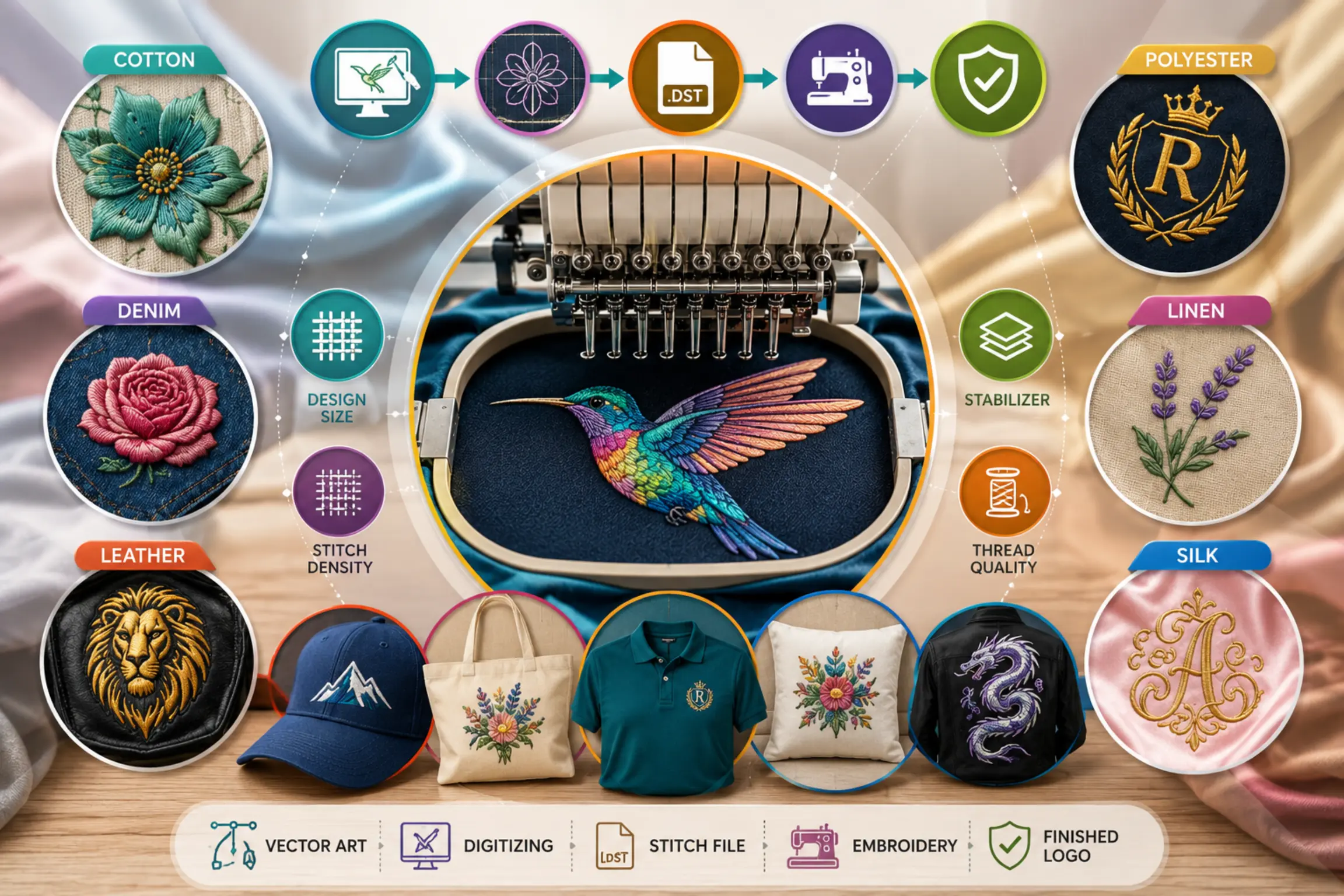
Choosing the right embroidery machine design is about more than simply selecting a beautiful pattern. The fabric you are working with has a major impact on how an embroidery design will look, stitch, and perform. A design that works perfectly on a structured denim jacket may look distorted, puckered, or overly dense when stitched onto a lightweight cotton shirt.
This is where embroidery digitizing becomes especially important. A properly digitized design considers the fabric type, stretch, thickness, density, stitch direction, underlay, and other technical factors before the design reaches the embroidery machine.
Whether you are embroidering uniforms, caps, jackets, T-shirts, towels, bags, or promotional clothing, choosing a design that matches the fabric can significantly improve the final result.
Why Fabric Type Matters in Machine Embroidery
Every fabric behaves differently when it is hooped and stitched. Some materials are stable and firm, while others stretch, move, or have a loose structure.
When an embroidery machine places hundreds or thousands of stitches into fabric, it creates tension. If the fabric cannot properly support those stitches, several problems can occur, including:
- Fabric puckering
- Distorted lettering
- Uneven stitch coverage
- Design shifting
- Thread gaps
- Excessive thread density
- Poor registration
- Fabric damage
- Loss of detail
The same embroidery file should therefore not always be used unchanged on every fabric.
A professional digitizer can adjust the design’s stitch density, underlay, stitch direction, pull compensation, and sequencing according to the material being embroidered.
Understanding the Relationship Between Design and Fabric
Before choosing an embroidery design, consider three important factors:
1. Fabric Stability
Stable fabrics such as denim, canvas, and some woven cottons generally provide stronger support for embroidery. They can handle relatively detailed designs and higher stitch counts.
Stretchy fabrics such as jersey, polo shirts, and performance wear require more careful digitizing because the material can move and stretch during stitching.
2. Fabric Thickness
Thick materials can support heavier embroidery, while thin materials may become weighed down by dense stitching.
For lightweight fabrics, a design with excessive stitch density can create stiffness, puckering, or even small holes.
3. Fabric Texture
Texture also affects visibility. Embroidery on a smooth cotton shirt may appear very sharp, while embroidery on fleece, towels, or other textured fabrics can become partially hidden within the surface.
The design may need larger details, stronger underlay, or adjusted stitch settings to remain visible.
Best Embroidery Designs for Cotton Fabric
Cotton is one of the most commonly embroidered materials. It is available in many weights, from lightweight shirts to heavier woven fabrics.
For relatively stable cotton, you can use:
- Logo embroidery
- Monograms
- Decorative motifs
- Small illustrations
- Text designs
- Detailed brand marks
However, lightweight cotton requires more attention than heavy cotton.
A design that is too dense can pull the material together and create puckering. For lightweight cotton garments, simpler designs with controlled stitch density are often more effective.
Digitizing tip: Use appropriate underlay and pull compensation while avoiding unnecessary stitch density.
Choosing Designs for T-Shirts and Jersey Fabrics
T-shirts and jersey materials are typically more challenging because they can stretch easily.
Large, heavy embroidery can make a T-shirt feel stiff and uncomfortable. It can also cause distortion around the embroidered area.
For these fabrics, consider:
- Simple logos
- Medium-sized designs
- Clean lettering
- Open stitch areas
- Moderate stitch density
- Proper stabilizing
Fine details should be evaluated carefully because small elements can become difficult to reproduce accurately on a flexible surface.
A professional digitized design should account for fabric movement rather than simply converting an image into stitches.
Embroidery Designs for Denim
Denim is thick, durable, and relatively stable, making it an excellent fabric for embroidery.
It can support:
- Large logos
- Bold lettering
- Detailed artwork
- Decorative patterns
- Back-jacket designs
- Patches and emblems
Because denim is strong, designs can generally be more substantial than those used on lightweight garments.
However, excessive stitch density can still create unnecessary bulk. The thickness of the fabric and multiple layers around seams or pockets should also be considered when selecting the embroidery location.
Choosing Designs for Fleece
Fleece presents a different challenge because its soft surface can hide embroidery stitches.
Small details may disappear into the fabric, particularly when the design contains thin lines or small lettering.
For fleece garments, consider designs with:
- Strong outlines
- Larger elements
- Clear lettering
- Suitable underlay
- Appropriate stitch density
The digitizer may need to use stronger foundation stitching to help keep the embroidery visible above the fabric surface.
Embroidery on Towels and Terry Cloth
Towels have a highly textured surface, which can make detailed embroidery difficult.
The loops of terry cloth can rise around the stitches and partially cover the design.
For towels, bathrobes, and similar materials, designs should generally be:
- Bold
- Clear
- Relatively simple
- Large enough to remain visible
- Properly digitized for textured fabric
Names, monograms, and bold logos often work particularly well.
A suitable underlay can help prevent the towel loops from interfering with the embroidery.
Choosing Designs for Canvas and Heavy Materials
Canvas is another strong fabric that can handle substantial embroidery.
It is commonly used for:
- Tote bags
- Workwear
- Aprons
- Backpacks
- Caps
- Accessories
Because canvas is firm, it can support relatively detailed and bold designs. However, the embroidery machine must also be able to handle the material’s thickness, particularly where multiple layers overlap.
When embroidering bags, pay special attention to seams, pockets, zippers, and construction layers.
Embroidery Designs for Caps and Hats
Caps require special consideration because their curved shape affects how embroidery is stitched.
Large, highly detailed designs may not always work well on a curved cap front. Small lettering and fine details can also become difficult to reproduce.
For caps, designs often work best when they are:
- Bold
- Compact
- Clearly defined
- Properly sized
- Designed around the cap’s shape
Cap embroidery also requires appropriate digitizing techniques because the needle moves across a curved and sometimes uneven surface.
Choosing Designs for Stretch and Performance Fabrics
Sportswear and performance garments often contain materials such as polyester blends, spandex, or other flexible fabrics.
These materials can stretch considerably, making stabilization particularly important.
For performance fabrics, avoid unnecessarily heavy embroidery. Lightweight and medium-density designs are often more suitable.
Good choices include:
- Sports team logos
- Small brand marks
- Player names
- Numbers
- Simple symbols
- Clean lettering
The embroidery should maintain flexibility while still providing sufficient coverage and definition.
How Embroidery Density Affects Different Fabrics
Stitch density refers to how closely stitches are placed within a design.
High density is not automatically better.
Too many stitches can:
- Make embroidery stiff
- Increase production time
- Increase thread consumption
- Cause puckering
- Put unnecessary stress on fabric
- Reduce garment comfort
On the other hand, insufficient density can result in poor coverage and visible fabric underneath the embroidery.
The goal is to achieve the right density for the specific fabric and design.
This is one reason professional embroidery digitizing is so important.
The Importance of Underlay
Underlay is the foundation stitching placed underneath the visible embroidery.
It helps:
- Stabilize the fabric
- Support the top stitches
- Improve registration
- Prevent distortion
- Keep embroidery defined
Different fabrics may require different underlay strategies.
For example, stretchy fabrics generally need more structural support than firm woven materials. Textured fabrics may also require underlay that helps hold the embroidery above the surface.
Using the wrong underlay can negatively affect the final result even if the artwork itself looks perfect on screen.
Consider Design Size Before Stitching
The size of an embroidery design should match both the fabric and the intended placement.
A design that looks excellent at 10 inches wide may not look good when reduced to 2 inches.
When a design becomes too small:
- Small lettering may disappear
- Fine lines may merge
- Details become difficult to reproduce
- Stitch density may become problematic
For small embroidery, simplify the artwork rather than simply shrinking it.
This is especially important for logos containing tiny text or intricate details.
Match Stitch Types to the Design
Different embroidery elements may require different stitch types.
Common stitch types include:
Satin stitches: Excellent for borders, lettering, and narrow shapes.
Fill stitches: Suitable for larger areas that require coverage.
Running stitches: Useful for outlines and fine details.
Choosing the right stitch type can improve both appearance and durability.
For example, satin stitches are often effective for bold lettering, while large areas may be better handled with carefully planned fill stitches.
Stitch Direction Also Matters
Stitch direction can influence the appearance and stability of embroidery.
Changing stitch angles can add visual dimension and help distribute tension more effectively.
Poorly planned stitch direction can contribute to:
- Uneven appearance
- Fabric distortion
- Unwanted gaps
- Poor registration
A professional digitizer considers how different sections of the design interact rather than treating every area independently.
Don’t Forget Thread and Color Selection
Fabric color can significantly influence how embroidery colors appear.
A thread color that looks vibrant on white fabric may have less contrast against a dark garment.
Before stitching, consider:
- Fabric color
- Thread color
- Contrast
- Design visibility
- Brand colors
- Thread type
For professional logos, maintaining brand colors is often important, but the colors may need to be adjusted slightly to ensure sufficient contrast with the chosen fabric.
Common Mistakes to Avoid
Using the Same File on Every Fabric
A design created for denim may not perform well on a lightweight T-shirt.
Making Designs Too Dense
More stitches do not necessarily mean better embroidery. Excessive density can create stiffness and puckering.
Ignoring Fabric Stretch
Stretchy garments require appropriate stabilization and digitizing adjustments.
Keeping Tiny Details
Very small details may disappear during embroidery, particularly on textured or flexible materials.
Choosing the Wrong Design Size
The design should be appropriate for its placement and the garment’s physical dimensions.
Skipping a Test Stitch-Out
A design can look perfect digitally but behave differently when actually embroidered. A test stitch-out helps identify problems before production.
Why Professional Embroidery Digitizing Makes a Difference
Embroidery digitizing is the process of converting artwork into a machine-readable embroidery file containing instructions for stitch placement, sequence, density, direction, and other parameters.
Professional digitizing isn’t simply about converting a JPG, PNG, or logo into stitches.
The digitizer needs to understand:
- Fabric characteristics
- Stitch types
- Stitch density
- Underlay
- Pull compensation
- Registration
- Thread behavior
- Design sequencing
- Machine limitations
- Final embroidery placement
A professionally digitized design can therefore produce a much cleaner and more consistent result across different garments and materials.
How to Choose the Right Design: A Simple Checklist
Before sending a design to embroidery, ask:
- What type of fabric am I using?
- Is the fabric lightweight, medium, or heavy?
- Does it stretch?
- Is the surface smooth or textured?
- Where will the embroidery be placed?
- How large should the design be?
- Does the design contain very small details?
- Is the stitch density appropriate?
- Does the design need additional stabilization?
- Has the embroidery file been tested on the actual fabric?
Answering these questions can prevent many common embroidery problems.
Final Thoughts
Choosing the right embroidery machine design for different fabric types is essential for achieving professional-looking results. The best design isn’t necessarily the most detailed one—it is the design that works harmoniously with the fabric, garment construction, embroidery placement, and machine.
Stable materials such as denim and canvas can support bold and detailed designs, while lightweight and stretchy fabrics usually benefit from simpler artwork, controlled density, and stronger stabilization. Textured materials such as towels and fleece require designs that remain visible above the fabric surface.
Most importantly, professional embroidery digitizing should be adapted to the material rather than treating every fabric the same way.
At ASH Digitizing, we understand that every embroidery project has different requirements. Our embroidery digitizing services focus on creating machine-ready designs that are properly optimized for fabric type, design size, stitch structure, and production needs. Whether you need a logo for a T-shirt, detailed artwork for a jacket, branding for uniforms, or embroidery for caps and other garments, proper digitizing can make a significant difference in the final result.